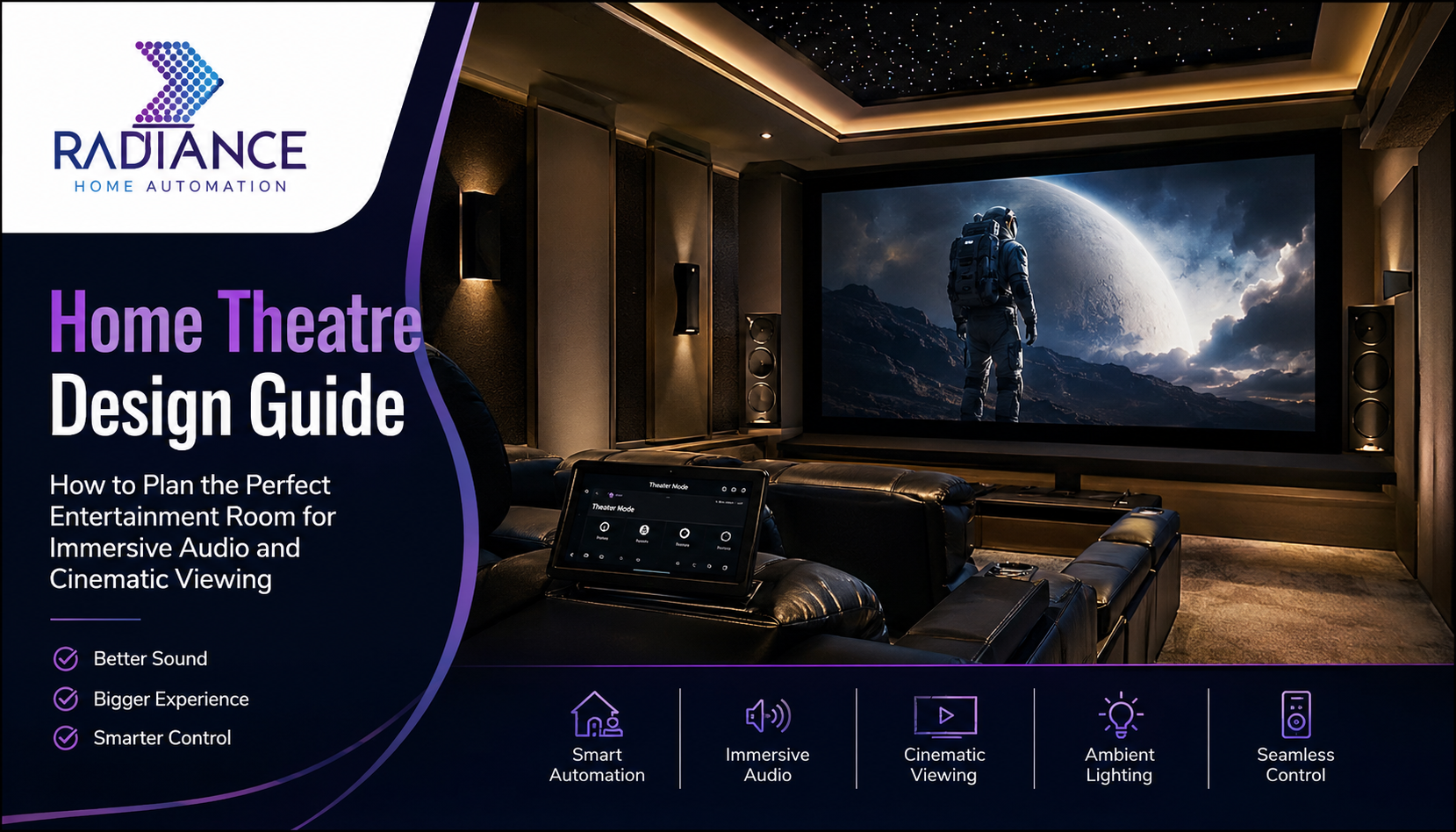
A television mounted on a living room wall delivers content. A properly designed smart home theater delivers an experience that engages every sense, transports attention completely, and creates memories that casual viewing never achieves. The gap between these two outcomes is not simply a matter of screen size or speaker count. It is a matter of design discipline — acoustic treatment, display calibration, seating geometry, lighting integration, and intelligent control all contributing simultaneously to an environment built specifically for immersive entertainment.
Radiance Automation designs and installs home theatre environments across Chennai with this distinction as the foundational principle behind every project we undertake.
Room Selection and Dimensional PlanningThe physical space chosen for a smart home theater determines what is achievable before a single component is selected. Room dimensions influence bass frequency response, screen viewing angles, and the speaker placement geometry that surround sound formats require to deliver their intended spatial imaging.
The length-to-width ratios of the rectangular rooms are in between 1.2:1 and 1.6:1 and are acoustically the best rooms. Standing wave issues in the rooms at particular bass frequencies will not be fully corrected with acoustic treatment of perfectly square rooms. Rooms that vary from one end to the other, have walls that are angled, or have a significant variation in ceiling height are acoustically unique, and can be solved only on a case-by-case basis.
Home Automation Companies in Chennai who are true experts in Home Theatre Solutions evaluate the size of the room, construction material before recommending any equipment. The sound reflection of concrete walls, tiled floors and glass surfaces is different from that of timber framed walls, carpeted floors and fabric covered surfaces. These reflectivity characteristics will inform all the following considerations involving speaker positioning, acoustic treatment and system design.
Display Technology: Projector Versus Large Format ScreenThe display choice defines the visual centrepiece of any smart home theater. Two primary options dominate contemporary installations: high-lumen laser projectors delivering screen images between 100 and 150 inches diagonally, and large-format LED displays in the 85 to 110-inch range offering superior brightness and contrast in rooms where ambient light control is imperfect.
The combination of laser projectors and acoustically transparent screens – screens with a hole behind the screen and a speaker – is the most realistic film experience. The dialogue channel is positioned just at the center of the picture screen, so that there is no delay between the sound source and the picture as usual in the speaker positioning.
Home Automation Companies in Chennai installing projector-based systems must account for throw distance, lens shift capability, and screen gain within the specific room geometry. A projector specified for the wrong throw distance either cannot fill the intended screen size or requires placement that conflicts with seating positions and sight lines.
If the ambient light in the room is higher or ceiling height is not sufficient for the projector throw distance, then large format LED displays are suitable for such rooms. They are also brighter than other projectors in the same price range, and have a natural contrast ratio that results in superb HDR viewing in anything but pitch black conditions.
Surround Sound Formats and Speaker PlacementModern smart home theater audio includes surround sound, but in a 3-D fashion, such as Dolby Atmos and DTS:X. This space-based spatial audio demands special placement configurations with speakers that are different in nature from previous channel-based surround configurations.
The current standard in high quality home theatre audio is the 7.1.4 configuration of surround sound, subwoofer and 4 height channels. The four height channels are used in the same way as in-ceiling speakers, but positioned above and slightly forward and behind the main listening position to provide the vertical dimension so that overhead sounds like rain, aircraft or falling objects are believable — not obviously fake.
Home Automation Companies in Chennai specifying Atmos systems must calculate speaker angles relative to the listening position with precision. The Dolby and DTS installation guidelines specify precise azimuth and elevation angles for each speaker position, and deviations from these angles compromise the spatial imaging that makes object-based audio worth implementing in the first place.
Subwoofer placement deserves particular attention in smaller rooms where low-frequency room modes create uneven bass distribution. Dual subwoofers placed at opposing positions within the room, combined with room correction processing, produce far more even bass response across all seating positions than a single subwoofer regardless of its output capability.
Acoustic Treatment: The Investment Most Buyers UnderestimateEven the best looking smart home theater with great equipment will have a bad performance when it comes to acoustics if it is not treated properly. Untreated rooms will receive reflections from hard surfaces milliseconds later than the direct sound, which will result in poor stereo imaging, poor dialog intelligibility and poor spatial detail, which is what surround sound formats have been created to provide.
Acoustic panels positioned at first reflection points — the wall and ceiling surfaces where sound bounces directly toward the listening position from each speaker — absorb these early reflections before they cause audible interference. Bass traps installed at room corners address the low-frequency accumulation that corner placement generates. Diffuser panels at the rear wall scatter remaining energy rather than absorbing it, maintaining acoustic liveliness without creating the echo-prone environment that bare surfaces produce.
Home Automation Companies in Chennai
incorporate acoustic treatment in the home theatre designs as an integral part of the design instead of it being an added feature. Treatment materials and their location are planned for in the design stage before construction and finishing work commences, so that the integration of the panels can be designed as a part of the building, instead of as an after-fought appearance. Control Integration That Makes Everything EffortlessThe most technically accomplished smart home theater loses significant value if operating it requires navigating multiple remote controls and memorising complex input switching sequences. Radiance Automation integrates every component, projector or display, AV processor, amplifiers, streaming sources, lighting, and motorised elements, within a unified control system accessible through a single touchpanel, smartphone application, or voice command.
This operational simplicity is where Home Automation Companies in Chennai with genuine integration expertise deliver value that equipment-focused installers cannot match. The technology becomes invisible. The experience becomes effortless. And the room fulfills its purpose every time, without friction or frustration.